Apollo lost $1.1 billion mostly on rate marks at its retirement arm and called it a strong quarter
Higher rates hit unrealized values at Athene, Apollo's retirement business, and pushed the firm to a GAAP loss. Its CEO led with record origination. The loss deserved the top line.
By Connor O'Brien ·
Why it matters: Apollo pairs retirement products with private credit. Rate marks in that segment drove a $1.1 billion GAAP loss, which tests how clearly it explains its balance sheet risk.
For information only, not investment advice. Prices delayed.
Tickers: APO
Apollo Global Management ($APO) lost money this quarter, and a lot of it. Its earnings presentation puts it plainly: “GAAP Net Loss Attributable to Apollo Global Management, Inc. Common Stockholders was $1.1 billion for the quarter ended September 30, 2026, or $(1.78) per share, driven primarily by unrealized mark-to-market losses on certain investments within the Retirement Services segment resulting from higher interest rates.”
Then read the press release. Chief executive Marc Rowan said: “Our strong third quarter results reflect the flywheel of our model, which starts with originating increasing amounts of good assets.” And: “Origination reached a new high of $114 billion in the quarter, and over the last twelve months, activity exceeded $350 billion while our clients entrusted us with $270 billion of inflows.”
Both of those things can be true. My problem is which one Apollo wants you to lead with, and why that matters more at Apollo than at almost any other asset manager.
The loss sits where the retirement money is
Apollo isn't just a fund shop. Its own release describes the other half: “Through Athene, our retirement services business, we specialize in helping clients achieve financial security by providing a suite of retirement savings products and acting as a solutions provider to institutions.” That's the Retirement Services segment, and it's where the marks that primarily drove the loss landed.
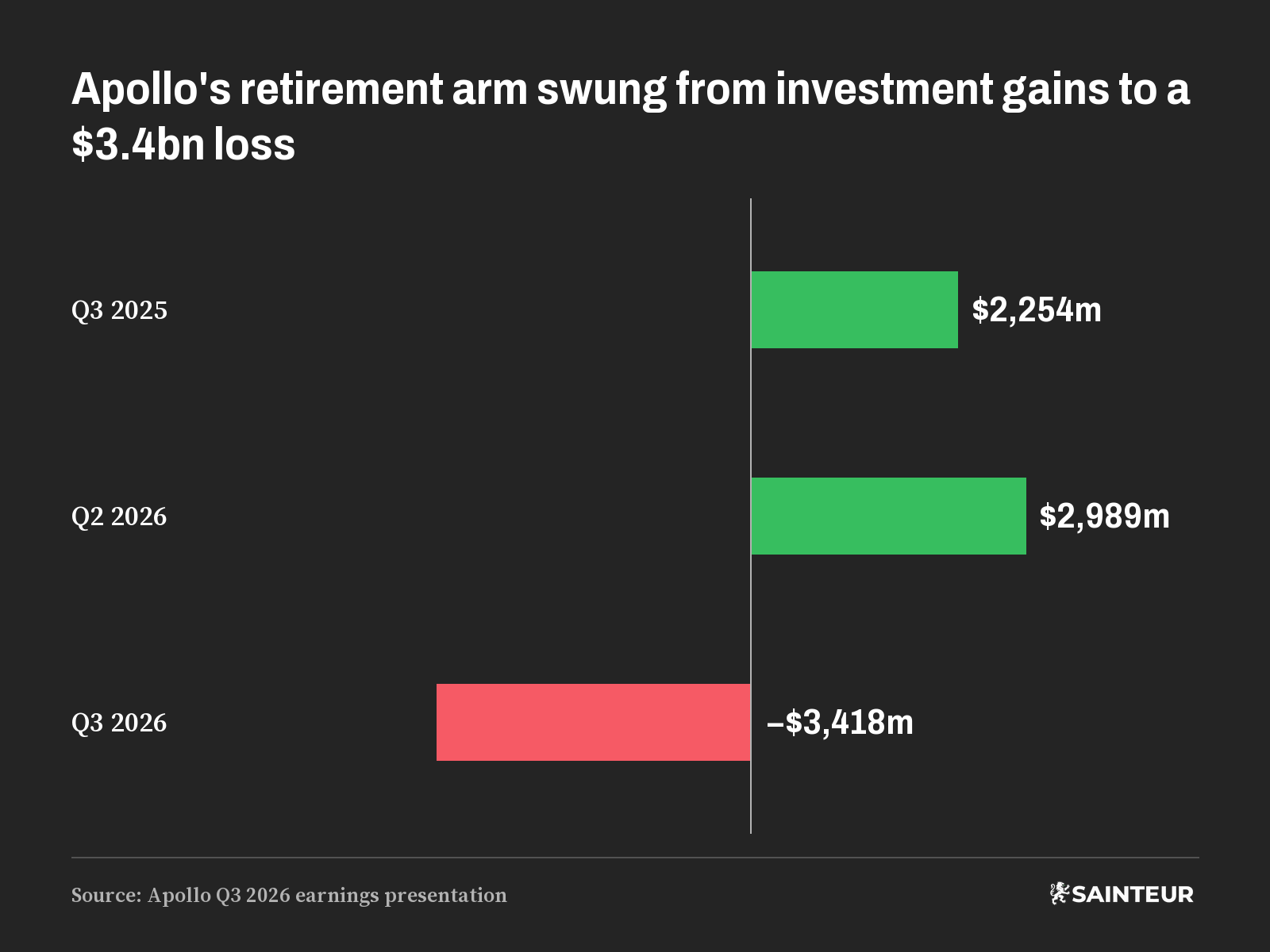
The line in the presentation for Retirement Services investment-related gains and losses shows a loss of $3,418 million for the third quarter, against gains of $2,989 million in the second quarter and $2,254 million a year earlier. The asset-management side's investment income turned negative too, at a $188 million loss.
The pitch for marrying an annuity business to a credit machine is that the annuity money is a patient, stable source of funding for the loans Apollo originates. That pitch has a rate sensitivity built into it, and this quarter showed it. When higher rates can flip that line from a gain to a loss in one quarter, the people who bought those retirement products have a stake in how that balance sheet is marked. A cheerful headline number doesn't help them understand it.
The best case for Apollo
Here's the strongest version of the other side, and it's a real one. The losses are, in Apollo's words, unrealized mark-to-market losses. Apollo describes them as unrealized marks, not defaults. If the assets are held to maturity and pay as expected, much of that markdown can come back. Apollo's preferred measure tells a steadier story: “Apollo's primary non-GAAP earnings metric, Adjusted Net Income, which represents the sum of FRE, SRE, and PII, less HoldCo interest and other financing costs and taxes, totaled $1.3 billion, or $2.07 per share, for the third quarter.”
The business is also still growing. Rowan said: “Behind record pipelines and tangible momentum across the business, our core earnings power is growing and poised for a robust close to 2026 with a strong setup for 2027.” The board kept the payout: “Apollo Global Management, Inc. has declared a cash dividend of $0.5625 per share of its Common Stock for the third quarter ended September 30, 2026.” And: “As of September 30, 2026, Apollo had approximately $1.07 trillion of assets under management.” For a firm that size, one quarter of rate marks may say little about whether its loans are any good.
I'll take that seriously. But “unrealized” describes timing, not safety. A firm asking retirees and institutions to trust its balance sheet should lead with what higher rates did to its reported earnings, rather than emphasizing its origination flywheel.
What I want to hear next
Investors seem to be weighing the same question. Apollo shares were at $113.29, down 5.16%, as of 12:14 PM ET Nov 3 on the Sainteur ticker. I'm not saying what that price should be. I'm saying the next release should open with the $1.1 billion, explain how much of it Apollo expects to reverse, and then talk about the flywheel. Strong quarters don't usually need the GAAP loss in the second paragraph.
Sources
- Apollo Reports Third Quarter 2026 Results (8-K exhibit 99.1), Apollo Global Management
- Apollo third quarter 2026 earnings presentation (8-K exhibit 99.2), Apollo Global Management
Tags: earnings · interest-rates · markets-moves