Oracle set a $20 billion cap on new market funding, then filed for all of it five days later
Oracle pledged to limit new capital raises through FY30 to $10 billion of stock and $10 billion of debt. On Monday it filed for both. That's a schedule, not a discipline.
By Connor O'Brien ·
Why it matters: Oracle's proposed $20 billion raise is a test of how far AI spending promises can be trusted, on a day oil fell and tech still sold off.
For information only, not investment advice. Prices delayed.
Tickers: ORCL
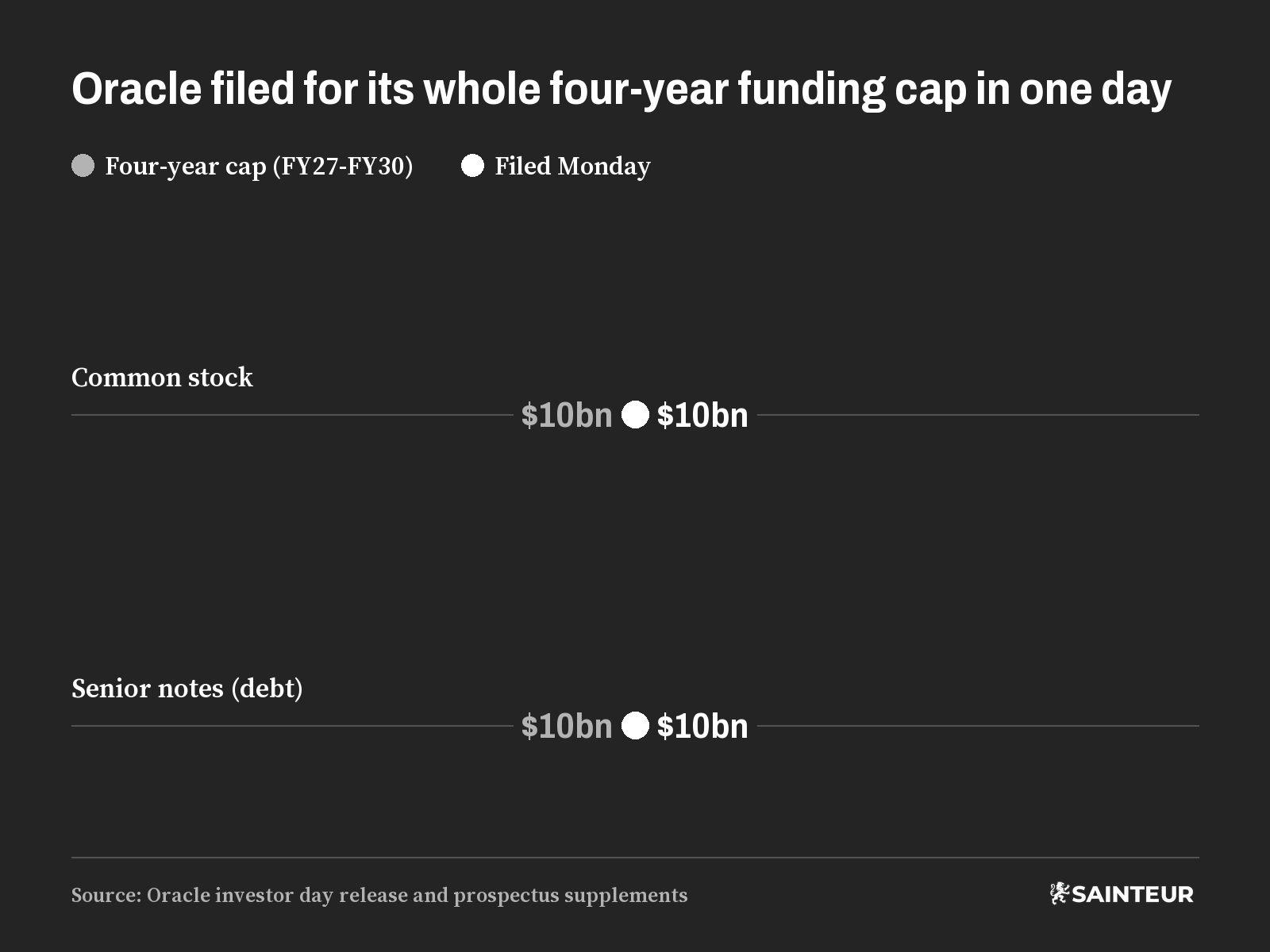
Last week Oracle ($ORCL) gave investors a number to hold it to. At its investor day, the company said: “Oracle committed to limiting additional funding to be raised in the capital markets for its FY27-FY30 investment cycle to $20 billion, currently expected to be $10 billion in equity and $10 billion in gross debt.”
On Monday it filed to raise $10 billion in common stock and, at the same time, $10 billion in senior notes. The equity prospectus says so in two sentences: “We are offering $10,000,000,000 of shares of our common stock, par value $0.01 per share (“common stock”).” And: “Concurrently with this offering and pursuant to a separate prospectus supplement, we are making a public offering of $10,000,000,000 aggregate principal amount of senior notes (collectively, the “Notes,” and the offering thereof, the “Concurrent Notes Offering”).”
Put those side by side. The four-year capital-raising limit was $10 billion of equity and $10 billion of debt. Monday's filings are $10 billion of equity and $10 billion of debt. Here's my view: a cap you move to use up in one trading day isn't a discipline. It's a schedule, and the schedule says Oracle needs the money now.
The market read the same arithmetic
Oracle closed at $119.22 on Monday, down 8.76%, as of 4:00 PM ET on the Sainteur ticker. CNBC reported that “Oracle shares also declined 8% after the company said it plans to sell $10 billion in common stock as well as $10 billion in bonds to finance its AI buildout.” The equity prospectus put the last reported sale price on the prior trading day at $130.67.
That fall came on a day when oil should have done the heavy lifting for stocks. Per CNBC: “Meanwhile, Brent crude tumbled 7.63% to close at $104.77 per barrel.” Cheaper energy is the kind of news that used to rescue a tape. Instead, “The tech-heavy Nasdaq dipped 1.07% to end at 25,164.32, while the S&P 500 shed 0.51% to close at 7,541.40.” And: “Both benchmarks were up as much as 1.4% and 1.1%, respectively.”
This is the backdrop Oracle chose to sell into. CNBC again: “Last week, the tech-heavy Nasdaq and the S&P 500 logged a losing October amid AI spending concerns, with the Nasdaq suffering its worst losses since March 2025.” The AI trade's problem right now isn't Iran or crude. It's the bill, and Monday Oracle handed investors a $20 billion piece of it.
The best case for Oracle
Here's the strongest version of the other side, and it's a real one. Oracle didn't break its promise. It did exactly what it said, in exactly the split it said: $10 billion of equity, $10 billion of debt. On paper, the two filings land exactly on the cap, not over it.
Raising early can also be the prudent move. If you know you need the money for a multi-year build, you take it while the window is open, rather than hoping the market is friendlier in a year. Oracle also tied the cap to an endgame. Its release said it: “Confirmed that growth will be self-funded beginning in FY29 and net debt to adjusted EBITDA will be below 3.5 times in FY29.”
And the broader market isn't panicking. As CNBC reported it: "The stock market's longer-term bullish narrative may have taken some hits in recent weeks, but it's still intact," said Chris Larkin, managing director of trading and investing at E-Trade.
Why I still think the cap is being spent, not kept
Keeping the letter of a promise isn't the same as keeping its point. A four-year cap tells investors the company can pace itself. Filing for all of it the following Monday tells them the opposite: that the need is front-loaded, and whatever happens between now and FY30 will lean on cash flow, vendor financing and customer prepayments.
That raises the stakes on the self-funding target, not lowers them. Note the fine print in the investor-day release: “This incremental funding requirement excludes refinancing of existing debt. This is in addition to the $20 billion at-the-market equity raise completed in the first quarter of fiscal 2027.” So the $20 billion cap sits on top of another $20 billion of stock already sold, and outside any refinancing.
The filings don't say the money is earmarked for data centers, either. The prospectus uses the standard language: “The net proceeds of this offering and the Concurrent Notes Offering, if completed, will be used for general corporate purposes, which may include capital expenditures, repayment of indebtedness, future investments or acquisitions and payment of cash dividends on or repurchases of our common stock.” And the notes prospectus left the rates blank, with maturities running out to 2046. The cost of this money isn't even set yet.
Oracle may well hit its FY29 targets, and I'll say so loudly if it does. But the honest reading of Monday is that the cap was a ceiling Oracle walked straight up to. When the next round of AI spending needs funding, investors will remember how long the last promise lasted.
Sources
- Oracle investor day release (8-K exhibit 99.1), Oracle Corporation
- Prospectus supplement: $10,000,000,000 common stock (424B5), Oracle Corporation
- Prospectus supplement: senior notes (424B2), Oracle Corporation
- Nasdaq starts November with 1% loss as tech melts down again, CNBC
Tags: ai · big-tech · markets-moves · guidance