Global credit spreads hit a 17-month high as AI borrowing fears spread to bonds
A Bloomberg index of global corporate bond spreads hit its widest since May 2025. This week Meta disclosed about $825 billion in commitments and a forecast need to raise hundreds of billions of dollars.
By James Mitchell ·
Why it matters: Wider credit spreads raise borrowing costs for companies funding AI and change what new bonds pay, so debt markets now matter for the AI trade.
For information only, not investment advice. Prices delayed.
Tickers: META, CRWV, ORCL, NVDA
The bond market is starting to send the AI boom a bill. Global corporate bond yield premiums, the extra interest companies pay over safer government debt, widened to 129 basis points on Thursday, Oct. 22. That is the widest since May 2025, according to a Bloomberg index. Bloomberg reported that global bond markets are signaling their biggest risk-off sentiment in more than a year, as a selloff in AI stocks and growing geopolitical tensions sent investors looking for safety.
The strain wasn't limited to US credit. According to Bloomberg, spreads on dollar bonds of higher-rated Asian companies widened to their highest levels since July 2025, and euro investment-grade corporate bond spreads hit their highest since May 2025. On Friday, the cost of protecting a basket of blue-chip US company debt against default rose to its highest level since March, Bloomberg reported. The volatility was enough for Export-Import Bank of Korea to postpone a yen bond sale.
Meta put a number on the borrowing question
Bloomberg reported that money managers' worries about AI debt sharpened this week after disclosures from Meta Platforms ($META). Meta said it has agreed to spend about $825 billion in the future on leases and contracts, many of them tied to AI computing and infrastructure. In July the same commitments stood at almost $700 billion. According to Meta's quarterly 10-Q filing, its contractual commitments mostly cover third-party cloud capacity, servers and network infrastructure, energy agreements for data centers and Reality Labs hardware.
The more telling number is in a separate filing. In an information statement filed with the SEC about its new class of non-voting stock, Meta said: "Moreover, the Company expects to need to raise capital to finance its AI-related growth plan." The filing says management's long-term forecasts, presented to the board, showed a "need to raise hundreds of billions of dollars over a period of several years beginning as early as fall 2026." Those are Meta's own forecasts, not an announced bond sale, and the statement is still preliminary. Bloomberg noted it is unclear how much of that will be borrowing.
Default insurance gets pricier
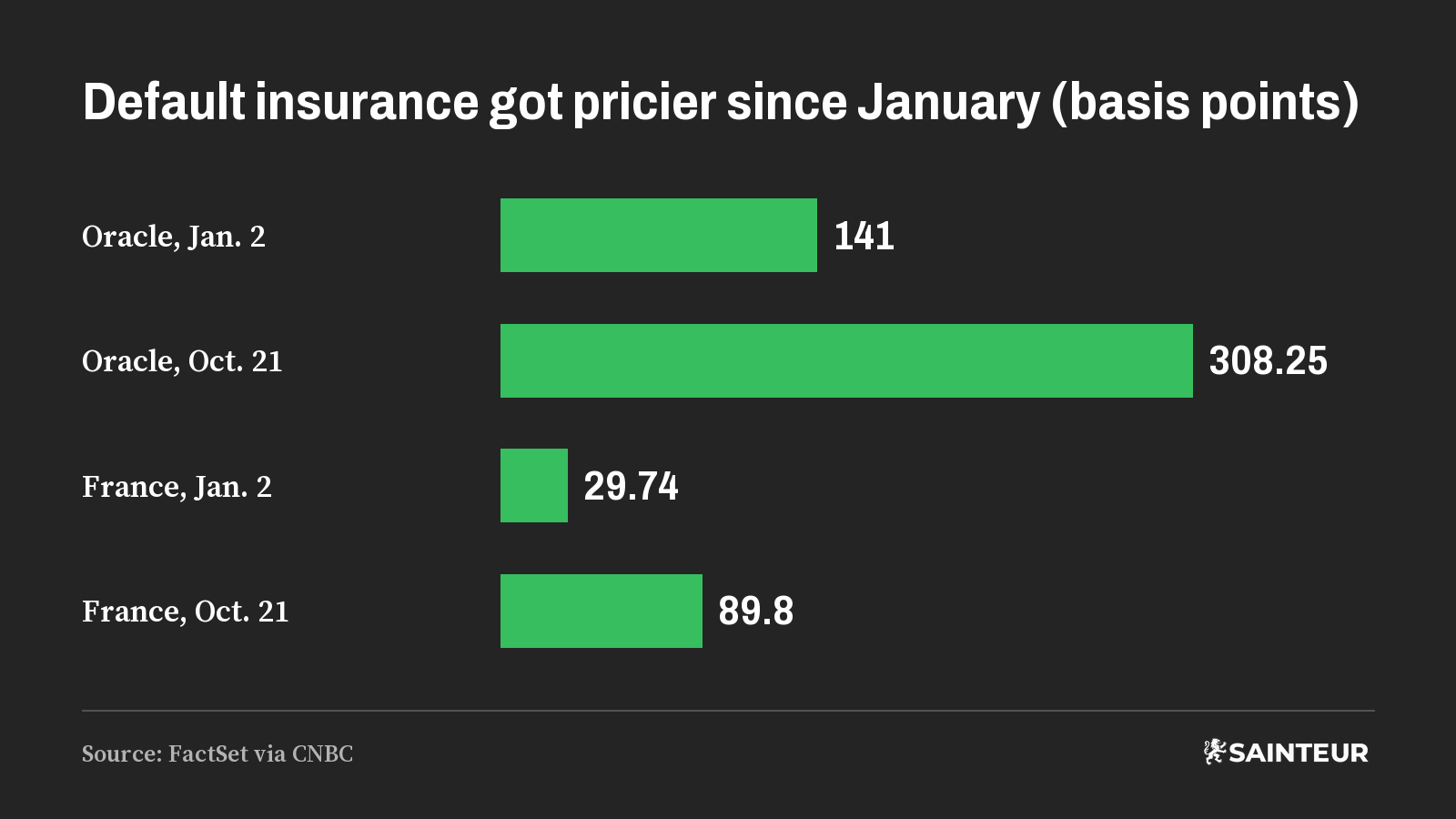
Credit default swaps, which work like insurance against a borrower missing payments, show the same unease. CNBC's analysis of FactSet data found that CoreWeave ($CRWV) had a five-year CDS spread of 1,065.84 basis points on Oct. 21, reflecting doubts about the debt-heavy company's ability to fund its expansion. The same measure for Oracle ($ORCL) rose to 308.25 basis points from 141 on Jan. 2. S&P downgraded Oracle's debt to the lowest investment-grade rung in July.
Even the industry's chip supplier sees it. Nvidia ($NVDA) CEO Jensen Huang told CNBC: "The demand of the capital is much greater than the availability of the capital," adding, "that's going to get solved."
Not only an AI story
Governments are competing for the same pool of money. CNBC reported that France's five-year CDS spread reached 89.8 basis points on Oct. 21, up from 29.74 on Jan. 2. The gap between French and German 10-year bond yields topped 170 basis points on Thursday for the first time since the euro zone debt crisis of the early 2010s. Bloomberg also listed rising oil prices and political unrest in France among the risks hanging over credit.
Investors ran to Treasuries. Bloomberg reported that US Treasuries rallied for their best day in more than two years on Thursday. By Friday, the rout in the AI trade faded somewhat, and Bloomberg's updated story said Treasuries gave back some of those gains.
For your money, this works in two directions. Wider spreads mean higher borrowing costs for companies funding the AI build-out, and they signal more perceived risk for the people who already hold that debt. For bond buyers, the flip side is more compensation for taking on corporate credit risk. Whether this week marks the start of a longer repricing or a brief scare is a forecast, and the sources here offer views, not answers.
Sources
- AI Tech Fears Push Global Credit Spreads to 17-Month High, Bloomberg News via Yahoo Finance
- AI Tech Fears Push Global Credit Spreads To 17-Month High, Bloomberg News via Financial Advisor
- Meta Reports $825 Billion in Future Spending Commitments, Bloomberg News via Yahoo Finance
- Meta Platforms Schedule 14C preliminary information statement, Meta Platforms Inc. (SEC filing)
- Meta Platforms Form 10-Q, quarter ended Sept. 30, 2026, Meta Platforms Inc. (SEC filing)
- AI debt and French bonds face a stress test: why it may not be over, CNBC
- France debt crisis: Could turmoil spread across the euro zone?, CNBC
Tags: markets-moves · ai · big-tech · treasury · europe · interest-rates